
Michigan Dual Enrollment: Opportunities for Change
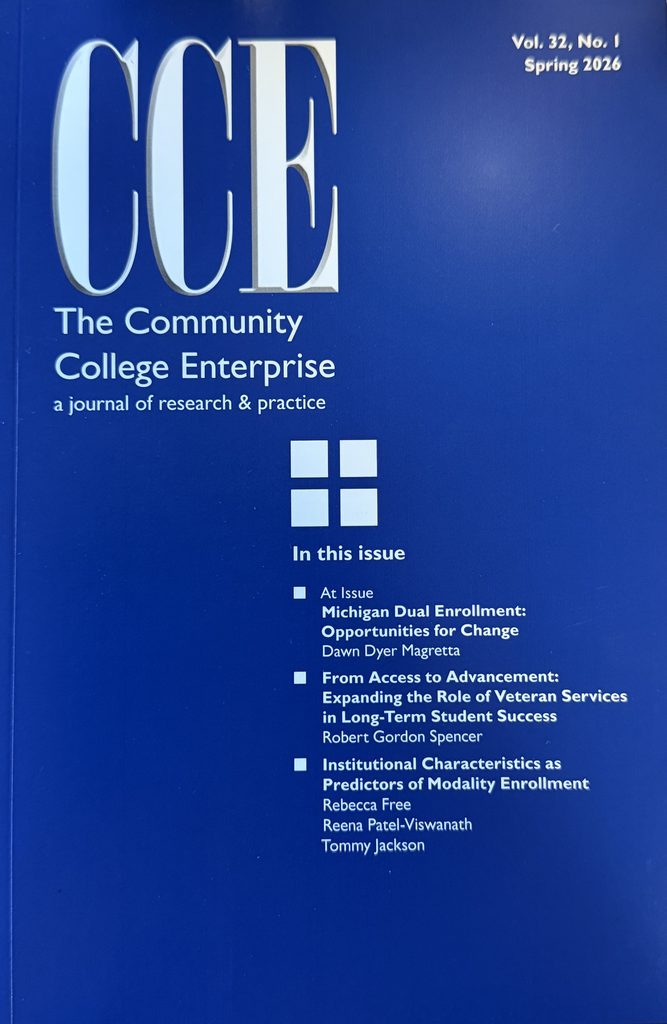
Schoolcraft College Foundation Executive Director Dawn Dyer Magretta shares her insights in Community College Enterprise in her recently published article, “Michigan Dual Enrollment: Opportunities for Change.”
As Michigan considers the future of postsecondary education, dual enrollment presents important opportunities to expand access, strengthen college and career pathways, and help students prepare for success beyond high school.
Read Dawn’s perspective on the opportunities for change and the future of dual enrollment in Michigan.
The future of postsecondary education in Michigan is clouded. Projected to face one of the steepest “enrollment cliffs” in the nation, Michigan community colleges are looking to do more with less so as to continue being the state’s economic drivers of educating the current and future workforce. By 2041, it is estimated that Michigan will see 20% fewer high school graduates than in 2023 (Lane et al., 2024). Even more concerning is that the total number of high school graduates pursuing a postsecondary education has declined by 8.8% since 2019 (Lohman and Wilkinson, 2025). Despite efforts to boost enrollment and completion, Michigan continues to lag behind most of the country when it comes to postsecondary education attainment (MI School Data, 2025). In short, Michigan is facing a future with fewer high school graduates, and even fewer of those graduates are pursuing a postsecondary education than in the past.
The so-called enrollment cliff is not a surprise. Institutions know it has arrived. Such a massive demographic shift requires strategic decisionmaking and budget forecasting at both the state and individual institutional levels. Higher education funding is a key piece of state budgeting. Across all state budgets it is one of the top four expenditures, alongside other educational funding, public welfare, and public health/hospitals (Urban Institute, 2023). For the 2025 fiscal year, total state spending on higher education was $129 billion, a 2% inflation-adjusted increase from 2024 (National Education Association, 2025). However, as Jennifer Delaney notes in her research, these funding levels have been a financial roller coaster, with funding often caught in boom-and-bust cycles (Delaney, 2023). A closer examination of 2025 state appropriations reveals that only half of the states have created funding levels that match or exceed prepandemic levels (National Education Association, 2025).
Dual Enrollment Growth
Among these seismic shifts, it has been revealed that there is at least one area of higher education that is experiencing considerable growth: dual enrollment. While not a new policy approach, states have recently begun to more fully embrace this new enrollment tool. Broadly, this approach allows high school students to complete collegiate courses while still in high school. Such programs promise to boost college enrollment, lower costs, improve student retention, and reduce a student’s time to completion. Today there are over 2.8 million dual enrolled students across the country (Fink, 2025). In Michigan, there are nearly 50,000 of these students, and they account for 9% of all undergraduate enrollments in the state. However, these totals still place Michigan near the bottom among all states based on the percentage of high schoolers who were dual enrolled (Fink, 2026).
As these programs have grown, states have embraced significantly different approaches to funding their dual enrollment programs. Research from the Community College Research Center (CCRC) points out that, aside from the level of available funds for dual enrollment in a given state, some states (e.g., Florida, Michigan, and Colorado) use a funding formula whereas others (e.g., Kansas, Illinois, Georgia) utilize grants or discretionary spending to fund the program (Jenkins et al., 2025).
To put a finer point on it, Michigan K–12 schools receive their state funding via a $10,050 per student foundation allowance. When a high school student participates in the dual enrollment program, the K–12 district must pay for the associated tuition and fees for the class up to the percentage of the student’s overall schedule that is tied to their collegiate selections. In other words, if a dual enrolled student’s schedule was 30% committed to a college, then their K–12 district would cover their college costs up to 30% of the foundational allowance. In this example, that total would be $3,015.
As a contrasting example, Texas has recently implemented its Financial Aid for Swift Transfer (FAST) program. Here, the Texas Higher Education Coordinating Board (THECB) sets a maximum tuition rate for dual enrollment contact hours. Colleges or universities that opt into the program receive these funds directly based on student dual enrollment numbers (Texas Higher Education Coordinating Board, 2025). In this approach, there is no financial penalty to the K–12 district for encouraging their students to pursue dual enrollment opportunities.
Regardless of the funding approach employed, a central concern facing all states in the expansion of dual enrollment is the equitable access of the program to all students. Some of these concerns can be addressed by structuring dual enrollment funding. Political and budgetary decisions made at the district level up through the state government have direct implications for access to dual enrollment programs. If expanding college access and completion is important, then participation cannot follow the aforementioned roller coaster of appropriations. In that model, only the most economically stable of districts and students will have access to these opportunities. This approach will further widen the inequities we see in our educational system.
The inequities of disparate models can be seen in the fact that Michigan’s high school students do not have the same opportunity as their peers in 90% of the country (Fink, 2025). Michigan has started to directly incentivize high school graduates to pursue a community college education through its Community College Guarantee (CCG). This program, targeting recent high school graduates, covers the tuition and fees for that student to attend a Michigan community college. However, despite the success of this policy, Michigan is still lacking meaningful incentives for K–12 districts to encourage students to become dual-enrolled at local community colleges.
In many places, Michigan high schools rely heavily on encouraging students to take Advanced Placement (AP) courses and do not make mention of dual enrollment or early middle college options. While AP courses are nationally recognized, obtaining college credits via examination is dependent on a strong exam performance and acceptance of the score from a particular college or university. While such an approach represents a cheaper individualistic pathway by which a state can encourage students to secure college credit while in high school, most students enrolled in an AP course do not pass their exams (Lichten, 2000).
Funding Challenges
Dual enrollment options in Michigan are governed by the Postsecondary Enrollment Options Act (1996 PA 160) and the Career and Technical Preparation Act (2000 PA 258). These laws allow high school students to take college courses not offered by their district, with costs supported by state aid. The funding for these dual enrollment opportunities flows through the Michigan State School Aid Act (1979 PA 94). The act requires local school districts pay colleges and universities directly for eligible course costs (tuition and fees). The state then reimburses districts for these costs up to the cap set by the per-pupil foundation allowance. It
is important to note that students may be responsible for costs not covered by the district.
This approach results in a direct funding reduction for districts where students elect to participate in dual enrollment. This is a direct disincentive for local districts to encourage or promote the dual enrollment option with their students. Additionally, if college costs (tuition and fees) exceed the per-pupil foundation allowance, families may be responsible for the difference. Finally, this funding can only be applied to courses that meet two requirements: (a) there are no duplicate offerings at the
high school, and (b) the course must directly lead to postsecondary credit, accreditation, certification, or licensing. Furthermore, compared to other states, Michigan’s model does not allow equitable access to dual enrollment opportunities for low-income students and socioeconomically-disadvantaged districts.
Although not the only factor, the state’s approach to dual enrollment funding has contributed to Michigan being one of the lowest ranked states in terms of the number of high school students taking college classes. The situation calls for a change.
In 2024, thanks to $1.2 million in state appropriations, Schoolcraft College piloted a program with five school districts that allowed their students to dual enroll at the college with no cost to the K–12 districts. The pilot increased the number of dual enrolled students by more than 87%, which signifies untapped potential program interest if funding was made available (Michigan Community College Association, 2025).
As such, the Michigan Community College Association (MCCA) has recommended more-equitable funding models, including: (a) covering full tuition costs to reduce family burden, (b) incentives for colleges to expand access, and (c) targeted support for marginalized students.
A New Policy Direction
Research has shown that, despite variations, dual enrollment programs continue to demonstrate positive effects. These cover pre- and post-high school graduation student outcomes, including building early college aspirations, experiences, and course credits, and increase affordability. Dual enrollment also supports increased student persistence and completion rates (Mann, 2023).
Michigan can modernize its dual enrollment program by eliminating financial barriers and by adopting centralized policies that are proven to increase these opportunities for students and improve the overall educational environment of the state. The core of this reform effort should be centered upon the following foundational pieces:
- Establish centralized funding for dual enrollment separate from the K–12 per-pupil funding allowance aligned with community college average costs. Such an approach could significantly reduce the overall per-pupil costs currently being spent. It would also provide a stable revenue stream that does not harm local school districts while allowing colleges to better forecast budgets for these students.
- Establish eligibility criteria beyond test scores to increase access, including students interested in professional trades.
- Improve outreach to students and families to better understand dual enrollment benefits and opportunities. Achieving this goal would accelerate progress toward Michigan’s Sixty by 30 goal— for 60% of Michigan adults to have obtained a postsecondary degree or certificate by 2030.
- Increase educational opportunities for all Michigan students, regardless of socioeconomic status.
- Expand dual enrollment to include in-demand, high-wage workforce credentials.
- Allow funding to cover education costs beyond tuition and fees
(such as transportation, books, and teacher credentialing).
Implementation Challenges
Of course, sweeping public policy change is not undertaken easily. Efforts to reform dual enrollment in Michigan, at least in the near future, will be difficult. However, the transformational change from rethinking the state’s approach to dual enrollment will provide benefits to Michigan students, K–12 districts, and postsecondary educational institutions.
Michigan’s K–12 and community college system is decentralized, with governance at the local level. Efforts to limit local control via centralization will be met with resistance. However, this model is designed to protect funding at the district level and pay tuition directly to the community college. Replacing the AP course model with dual enrollment will also face resistance from the College Board and high schools that will see their curriculum shifted.
Indeed, under the current dual enrollment approach K–12 districts have good reason to be concerned about the loss of student count to college courses. As previously shown, the current funding model directly harms district budgets when students become dual enrolled. However, as the 2024 program piloted at Schoolcraft College shows, it is possible for state leaders to create dual enrollment policies that do not punish K–12 districts, but rather encourage students to embrace a dual enrollment pathway.
Michigan should consider following the lead on dual enrollment that has been laid out in places such as California or Texas. By embracing a centralized, tuition-capped model, Michigan can reduce the amount being spent by the state on dual enrollment, and it would allow more students who are interested the opportunity to earn college credits at little or no direct cost for them or their families.
While Michigan offers the CCG for graduating high school students, dual enrollment presents a broader opportunity for students to start their college pathway earlier and encourages a transition directly into college. Research shows that dual-enrolled students have higher rates of persistence and completion when they dual enroll versus starting college after high school or later in life (Valesco et al., 2024). This also is a more effective use of state funds and taxpayer dollars.
Michigan stands at a crossroads: With one of the steepest enrollment cliffs in the nation and a dual enrollment system that is both costly and inequitable, the state risks falling behind in preparing its future workforce. Current funding models pit colleges and K–12 districts against each other. The result is diminished resources for K–12 districts, additional financial burden for families, and limited access for low-income and first-generation students.
By centralizing dual enrollment funding (separating it from per-pupil allowances and covering educational costs beyond tuition and fees) and expanding funding eligibility to include trades and workforce credential, Michigan can overcome many of the challenges found in the current model and open opportunities for successful college pathways for many more Michigan high school students. Such an approach has the potential to be more cost efficient and nonpunitive for K–12 districts, providing colleges with predictable revenue streams for long-term planning. Most importantly, it ensures equitable access for all students regardless of ZIP code or socioeconomic status.
References
Delany, J. (2023, August 30). Higher ed’s financial roller coaster. The
Chronicle of Higher Education. https://www.chronicle.com/article/higher-eds-financial-roller-coaster
Fink, J. (2025, September 30). High school dual enrollment grows to 2.8 million.
Community College Research Center. https://ccrc.tc.columbia.edu/easyblog/highschool-dual-enrollment-grows.html
Fink, J. (2026, January 13). Dual enrollment participation: Postsecondary enrollments among high school students, IPEDS 12-month enrollment: 2023-2024. Tableau Public. https://public.tableau.com/app/profile/john.fink/viz/
IPEDS12-MonthDualEnrollmentParticipation/Summary?publish=yes
Lane, P., Falkenstern, C., & Bransberger, P. (2024). Knocking at the college door:
Projections of high school graduates. Western Interstate Commission for Higher
Education. https://wiche.edu/knocking/key-findings/geography
Lohman, I., & Wilkinson, M. (2025, March 18). Michigan
spent millions lowering college costs. Enrollment has barely
budged. Bridge Michigan. https://bridgemi.com/talent-education/
michigan-spent-millions-lowering-college-costs-enrollment-has-barely-budged
Jenkins, D., Steiger, J., & Fink, J. (2025, October 22). How do states fund community college dual enrollment? Community College Research Center. https://
ccrc.tc.columbia.edu/easyblog/how-do-states-fund-community-college-dualenrollment.html
Lichten, W. (2000). Whither advanced placement? Education Policy Analysis Archives,
8(29). https://doi.org/10.14507/epaa.v8n29.2000
Mann, S. (2023, January). Advancing dual enrollment equity through state policy. Education Commission of the States. https://ecs.org/wp-content/uploads/Advancing-Dual-Enrollment-Equity-Through-State-Policy.pdf
Michigan Community College Association. (2025). Dual enrollment fact sheet:
Schoolcraft College pilot study. Dual Enrollment Resources. https://mcca.org/
uploads/ckeditor/files/Dual_Enrollment_Fact_Sheet_Schoolcraft_College_Pilot_Study.pdf
MI School Data. (2025, July 3). Postsecondary: Progress toward sixty by 30. https://mischooldata.org/progress-toward-sixty-by-30
National Education Association. (2025, September 12). State funding update: The fiscal and political crossroads facing public higher education. Higher Ed State Funding
Report. https://nea.org/resource-library/higher-ed-state-funding-report
Texas Higher Education Coordinating Board. (2025). Financial Aid for Swift
Transfer (FAST). Student Financial Aid Programs. https://highered.texas.gov/
student-financial-aid-programs/fast
52 Community College Enterprise • Spring 2026
Urban Institute. (2023, May). State and local backgrounders: Higher education
expenditures. https://urban.org/policy-centers/cross-center-initiatives/
state-and-local-finance-initiative/state-and-local-backgrounders/
higher-education-expenditures
Valesco, T., Fink., J., Bedoya, M., & Jenkins, D. (2024). The postsecondary outcomes
of high school dual enrollment students: A national and state-by-state analysis. Community College Research Center. https://ccrc.tc.columbia.edu/wp-content/uploads/2024/10/Postsec-Outcomes-Dual-Enrollment-Students-Revised-2025.pdf